
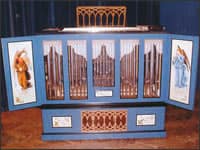
The new continuo organ for the Erin Arts Centre is of the type known to organ-builders as a ‘box organ.’ This is because all the pipes and mechanism are fitted into a very neat and convenient box-like form, which lends itself to concert halls, cathedrals, music colleges and other venues where there is a need for a small continuo organ which must also be portable and easily stored away. The specification (i.e. the stop list) is as follows:
· Stopt Diapason… 8′ (Wooden pipes)
· Flute… 4′ (Wooden pipes)
· Fifteenth … T (Metal pipes)
· 56 keys, 171 pipes.
The convenient form of the box organ comes at a cost to the organ-builder in that to design and build an instrument with three sets of pipes with the necessary key action, stop action and wind supply (the compressed air being provided by an electric blower) and have all this in a confined space without crowding the pipework, is a challenge which is as large as the organ is surprisingly small. Designing and building a box organ is therefore a specialised branch of organ-building which the great majority of builders do not care to tackle. The number of individual parts in the principal components gives some idea of the work involved in the actual construction:
· Keyboard: 679
· Soundboard: 1,221
· Casework, stop and key action: 1605
· Wooden Pipework: 741
· Metal Pipework: 285 In total… 4,531
The metal pipework was made to the specification of the Erin Arts Centre continuo organ by F. Booth & Son, of Leeds, specialists in metal pipe-making for many years. The electric blower was made by August Laukhuff of Weikersheim, the world’s largest organ-parts supplier. All other parts of the organ have been designed and made on the Isle of Man by Peter Jones of Foxdale, making this the first organ to be completely constructed by an Island-based firm since Moses Morgan’s Douglas-based workshop produced its last instrument almost 100 years ago.
Like all instruments of its type, this one has a modest tonal output. The construction of both the wooden and metal pipework has been based on the pipes found in the chamber organ at Sulby Methodist Church. This instrument is the oldest on the Island, and believed to date from around 1790. The gentle sounds of its wooden stops were seen as ideal for an organ intended to accompany a single instrumentalist or singer, or to be part of a small instrumental group, and, though the pipework in the new organ is made using modern materials and methods, it is easy to hear the antique charm of the original upon which it was modelled. The metal stop adds a brightness to the other two ranks of pipes when the organ is to be played at its loudest. In this sense, the Island’s newest organ owes a debt to its oldest. When the instrument was first discussed, it was suggested that some locally-grown timber be used, and so, whilst the raised keys on the keyboard are made from ebony, the natural keys are covered in spalted holly, a relatively rare wood which combines a beautiful grain pattern, good wearing properties and an attractive ‘touch’ from the viewpoint of the player. This timber was donated by the late Sir Clive Edwards from a tree growing in the grounds of his home at Milntown, near Ramsey. The wood had been allowed to lie in damp conditions for some time, after which it was stored close to the central heating furnace, and it is this combination of dampness followed by warmth which encourages the fungal growth which produces the distinctive patterning. The organ has several special features. For instance, it is possible for the player to reset the key mechanism so that the same keys will sound the pipes one note higher or one or two notes lower than standard, something which saves much mental effort when accompanying period or reproduction instruments built to play at pitches other than the ‘A440’, which is the universal standard today. Unusually for a pipe organ, this one is on wheels, and easily moved about the auditorium or stored away. Another unique feature is the panels which decorate its doors and frontage. Based on designs of the 13th century, these are the work of Iris Burton, an artist associated with the Erin Arts Centre from its earliest days, and provide the visual climax to the casework. This is an instrument, therefore, which is unique and has special ties to the Isle of Man and the Erin Arts Centre for which it was built. With care, its lifespan is indefinite, and its sounds will bring pleasure to future generations of music-lovers.
Peter Jones, designer and builder of the continuo organ, would welcome any comments. He can be contacted at:
The Bungalow
Kennaa
St John’s
Isle of Man
or care of the Erin Arts Centre.